
Written by Josh Alan Friedman
Photos by Peggy Bennett
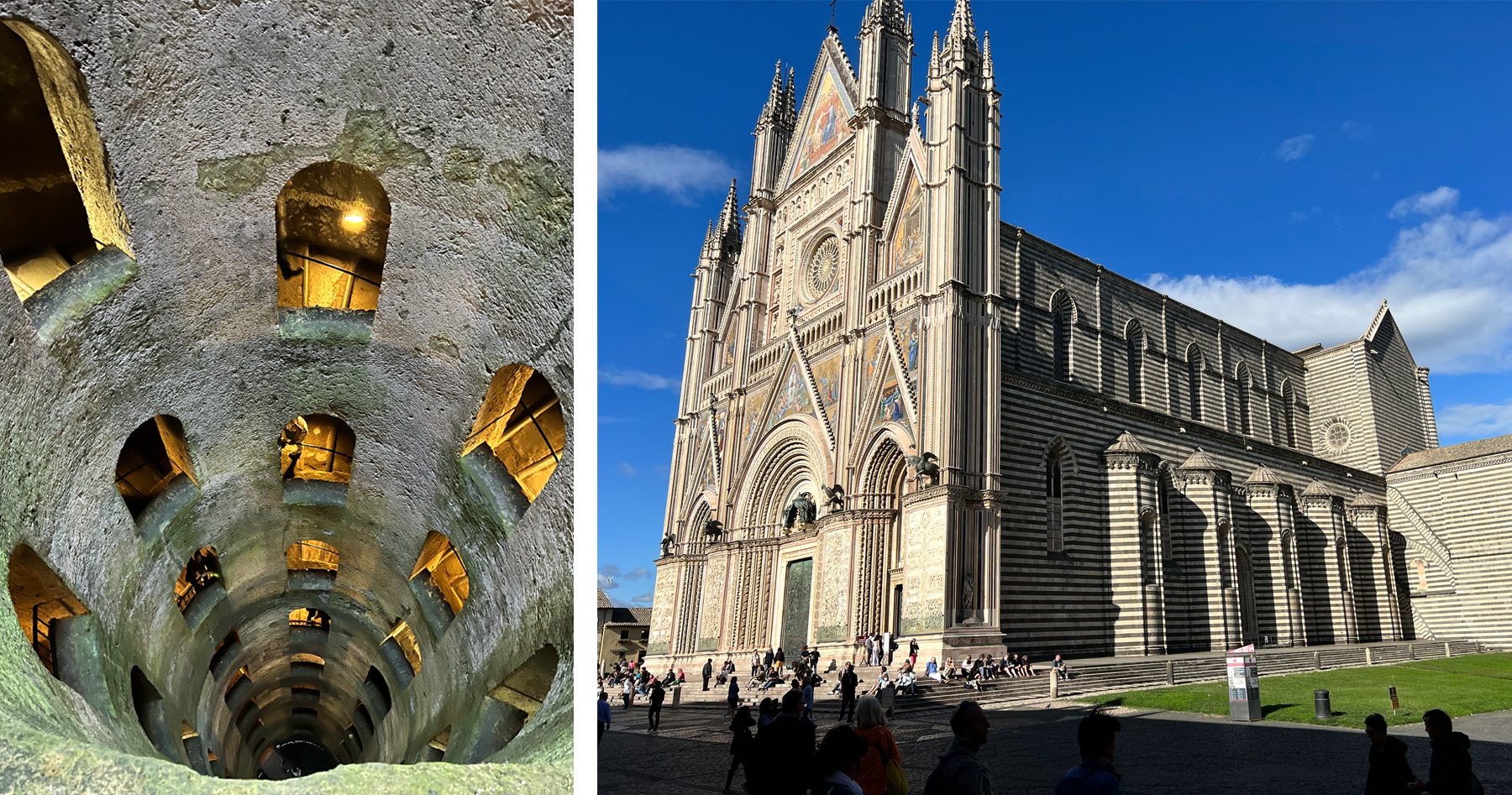
We exit the train from Rome to meet up with Wayfaring Walks in Orvieto, where man-made tunnels and cellars date back a thousand years. We wind down Saint Patrick’s Well, a hypnotic spiral staircase several stories deep. Above ground, the 13th century Duomo di Orvieto is a stunning combo of Gothic and Romanesque architecture. One of the most exquisite churches in Italy.
The Borgo la Chiaracia Resort & Spa, where we’ll spend the next three evenings, is more like a Scandinavian modern home than a hotel. It takes an act of bravery to plunge in, but the cold outdoor pool rejuvenates us after our walk each day.
A footbridge leads to the sparsely populated storybook hilltop town, Civita di Bagnoregio. Welcome to a Middle Ages fairy tale. A favorite among the cognoscenti, the town lurches up from a crest of rock above an eroding canyon. The footbridge serves as only point of entry from its sister town Bagnoregio, as the old donkey path disintegrated through time.

At the Janas farm in Porano, we’re greeted by its husband and wife team who have prepared a feast just for us. They are farmers and bakers of ancient-grain breads, supplying nearby restaurants. Several miles of walking through stone-cut paths have sharpened our appetite. Local bon bon goat cheese and cold cuts await, before they serve ancient-grain pasta with zucchini and black cabbage pie.
On another morning, we stroll through via Francigena, the old Roman dirt trail along the route to Lago di Bolsena. Gorgeous views of the lake keeping popping up in the distance. Can’t wait to jump in. Walking sticks are provided, which lend an extra jauntiness to our steps. A hundred sheep graze in a meadow. Wild boar inhabit the woods, but they keep themselves hidden far from humans. For that matter, throughout the week, we see almost no humans on these trails. Finally, seafood lunch is served on Lake Bolsena.

The Etruscans were master builders. To suddenly come upon medieval towns jutting out from the rock at the tops of mountains–it staggers our imagination that such stone architecture is possible. It’s as if they were built by the gods. The town of Sorano is made up of angular walkways and ubiquitous up and down steps. It feels like the set of an early German Expressionist movie. Another lunch is served in the restaurant opposite the green cliffs of an even higher mountain.
On the wooded trail we encounter a geese farm in the Tuscan pasture. The animals honk rudely in greeting. Deep pink Cyclamen flowers dot the pathway. And then after miles of hiking, just when in need of refreshment, an opening magically appears where walk manager Ron has provided lavish hors d’oeuvres laid out on a picnic table. Home base for the next three nights is the four-star Hotel Sovana. Once again, a cold pool provides therapeutic relief after hours of walking.

Of all the villages on this trip, Pitigliano has the most dramatic panoramic night skyline. The volcanic stone buildings jutting out of rock are illuminated. Why were its marble streets not crowded with tourists? This village, lesser known to the masses, is so cosmopolitan yet medieval. The very idea that credit cards are accepted in such ancient surroundings, by local artisans selling their wares, seems absurd. As if Visa was accepted by the Roman Empire. Pitigliano is the piece de resistance of all the Etruscan hilltop villages in this corner of Tuscany.
