
Fall is the perfect season to explore England on foot. And there’s nowhere more perfect to do that than in the Cotswolds.
This is the England we imagine. Where honey-colored cottages glow in the September sun. Peaceful village greens invite a leisurely stroll. And where the countryside unfolds before us with the timeless charm of a painting.
The enduring appeal of this region in the heart of middle England lies in its unique status as the “quintessential” English countryside. Spanning nearly 800 square miles across five counties, it is the country’s largest National Landscape.
It is rural, but not remote. Easy rail links make London less than a couple of hours away!
We’ll wander along ancient footpaths edged with turning leaves. There may be sweet hedgerow blackberries to sample as we pause for a view, a story, a grand garden, or simply to appreciate our surroundings. Perfect!

Join us to experience fall in the Cotswolds. A magical, slower-paced experience. Think misty mornings, amber-tinged landscapes, and fiery ivy clinging to honey-hued stone cottages.
The unique, light brown Cotswold limestone changes color as the daylight changes. And it changes geographically too, from north to south, from rich browns to a creamy almost-whites.
The word Cotswolds derives from two words: cot meaning a sheep enclosure and wold being a hill – the “sheep enclosures on the hills.”
A lot of the wealth in the area came from the wool trade. The wealthy medieval wool merchants and farmers donated money heavily to local churches to ease their path to heaven. These were often referred to as “wool churches”. They are larger and far more ornate than one might expect in relatively small country parishes.
There are countless miles of footpaths and bridleways to explore; ancient woodlands and wildflower meadows and some 4,000 miles of historic dry-stone walls dividing up the landscape!
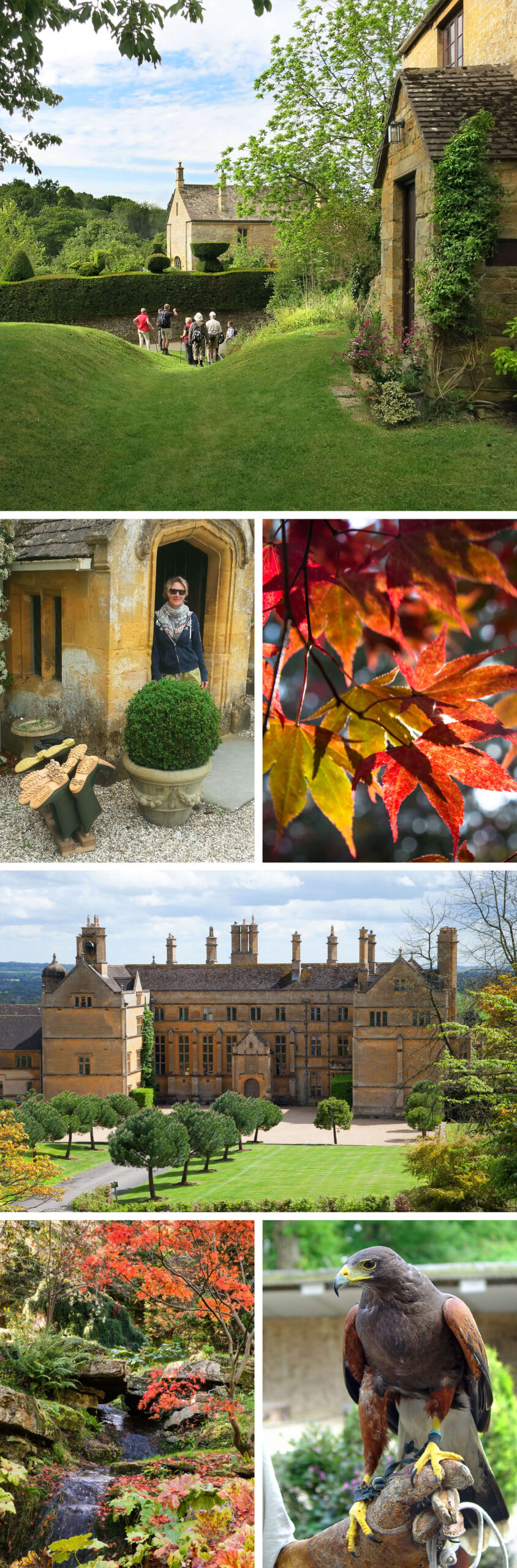
We’ll step into the carefully crafted beauty of Hidcote Manor Garden, where outdoor “rooms” unfold in a tapestry of late blooms and structured hedges, a vision brought to life a century ago by the “Quiet American Gardener” Lawrence Johnston.
At Batsford House, the season reveals itself in rich colours – fiery reds, burnished golds, and deep greens. Once part of the estate linked to the notorious Mitford sisters, this peaceful place is also home to the ancient and captivating art of falconry. We’ll watch an impressive demonstration as these stunning birds of prey take to the air.
A walk along a high escarpment brings us to Broadway Tower. Commanding stunning views of 60 miles across the Cotswold’s countryside and beyond, encompassing 16 counties – the most of any English viewpoint. It was built in 1794 and according to legend was sponsored by a local aristocrat who wanted to see if a beacon on the tower could be seen from her house in Worcester. Happily for its designer Capability Brown, the answer was that yes it could!
For something more mysterious, we visit Belas Knap. Wrapped in folklore and autumn silence, this ancient burial mound from around 3000 BCE invites quiet reflection.
Whether you believe in its legends or not, there’s an undeniable sense of age and atmosphere here. By the way, the impressive entrance is a dummy, and the burial chambers are entered from the sides of the barrow – when closed and covered by earth they would have been invisible from the outside. Some suggest that the false entrance functioned as a ‘spirit door’, intended to allow the dead to come and go and partake of offerings brought to the tomb by their descendants.
History lingers at Sudeley Castle, the only private castle in England to have a queen buried within its grounds. Here Katherine Parr, the last wife of Henry VIII, is laid to rest. Then a gentle walk leads to the evocative ruins of Hailes Abbey, where the echoes of Henry’s dissolution of the monasteries still shape the story of the landscape.